People get funny when talking about money. Whether it’s your salary, 401k value, new car price, or how much a trip costs, no one wants to come across as a pretentious braggart. Well, stuff costs money, and people spend their money in different ways. With that in mind I’m going to borrow an idea from my friends over at OneSixtyK and provide a weekly breakdown of what it’s costing me to hang out over here in Australia. My hope is that it helps someone plan for his or her own trip.
kentuckyfriedscott
current location : louisville, ky

Currency in a foreign land
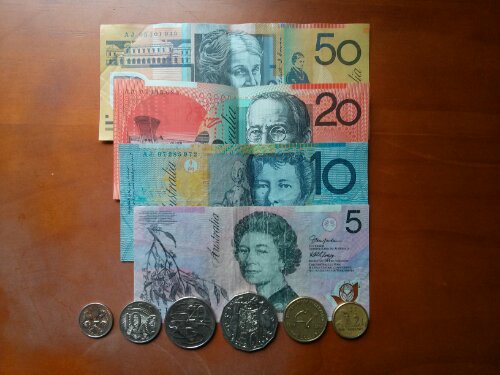
Money, scratch, dinero, coin, cash, moolah. Money doesn’t buy happiness but it does buy a cab ride or a falafel from a street vendor. Sure, credit cards are pretty much accepted eveywhere these days but cash is still king, which is why one of the first things you should become comfortable with in another country is their currency.
Six days ago I landed in Australia- the first time I had ever been on foreign soil (except for a trip to the Bahamas which doesn’t count). I went to the magic money machine at the airport (don’t do this, just use an ATM in the city), stuck in $200 US dollars and received A$161.80 in return. 😦 Of course I hadn’t researched Australian currency one bit so all of the sudden I had a bunch of colored pieces of paper and weird coins that felt about as useful to me as Monopoly money. It was intimidating but I found that you get the hang of it pretty quickly and cashiers will help you out even if they think you’re stupid.
Check out the pic above. The first thing I noticed is that Australian paper money comes in different sizes, getting smaller as the denomination decreases. I can only assume their A$100 is bigger than the A$50. There’s also a little transparent section on each bill which is kind of cool. Ok, so no big deal with the paper money. Where you can get in trouble is with the coins. See that little goldish one on the far right? That’s a A$2 coin and next to it is a A$1. In the US if you have a pocket full of change you might have, at best, three bucks or so (yeah we have $1 coins but when was the last time you used one?). Over here you could have A$20 in your pocket! Why their second smallest coin carries the most worth is a mystery to me.
So anyway, it doesn’t take long to get used to it. I guess the lesson is that in Australia you need to be more mindful of the little change in your pocket goin’ jing-a-ling-a-ling.
P.S. – for the curious: the coins across the bottom are, from left to right, $0.05, $0.10, $0.20, $0.50, $1.00, $2.00. I haven’t seen anything smaller than five cents.
Taronga Zoo
The other day I continued my tourist adventure of Sydney by visiting the Taronga Zoo. Like any red-blooded American, I’ve been to the zoo countless times. I was hoping for a unique experience on a completely different continent and that’s exactly what I got. The zoo was clean, well laid out, and staff were friendly. It’s across the harbor from downtown Sydney so you have to hop on a ferry, which was about a $10 round trip. From the ferry you’ll get up close and personal to the opera house as well as good photo ops of the harbour bridge.
I really want to edit some of these pics but a 7″ tablet makes that painful. I’d also love to post more pics and comment on a few but they take forever to upload and I’m tired of sitting in this apartment. Yesterday’s adventure involved borrowing a bike and a 25k roundtrip to the beach (that was interesting in a country that drives on the “wrong” side of the road) and today will be museum day (to avoid the sun and nurse my sunburn).
Without further adieu, the pics:


Fierce Snake – world’s most venomous land snake


And a video just for fun…
My first full day in Sydney

So, I’m probably just as curious as you about how this blog thing is going to turn out. I’ve never blogged before, nor have I ever been a journaler or a diary-ist. Gross. We’ll see how it goes.
The pic above is where I hung out most of the day Tuesday, which is Darling Harbour (note the Euro spelling because I’m refined now). No, that’s not the Sydney Opera House on the right. The Harbour is a tourist area with a super cool playground for kids (ahem), a great splash park, and all kinds of cool interactive water features. I didn’t take many pics because it was windy and rainy until around 5:00 pm. There’s a gift shop, a big grassy area (Tumbalong Park), many restaurants, the Chinese Garden of Friendship, an IMAX theater, aquarium, etc.
Things I did on my first full day in Sydney:
- Lots of walking.
- Started figuring out the train system. Public transit, in general, is pretty foreign to this Kentucky boy.
- People watching. The harbour is very touristy.
- Constant searching for free wifi as I had not yet activated my local cell service. For future reference, there is free wifi at the harbour near the McDonald’s. While sitting outside, a father and young boy and girl walked by. The boy asked “Ded, can we get Macca’s for dinnah?” To which the father replied “Macca’s or KFC on the way home?” “KFC on the way home” was the unison reply from both kids. Am I in the US?
- Watched The Hobbit in 3D on the largest IMAX screen in the world.
- Sunshine! Up until I left the movie theater I literally hadn’t seen the sun in about 36 hours.
- Discussed gun control in the US with a self-proclaimed bi-polar, schizophrenic, alcoholic while a homeless man dug through yet another McDonald’s garbage can and ate whatever he found. Poverty and people in need exist everywhere, it seems.
- Walked to Woolworth’s near where I’m staying for groceries. It’s funny how brands that were once huge in the US, but are now secondary, flourish here. There is a Woolworth’s, Aldi, and KMart in the nearby shopping mall.
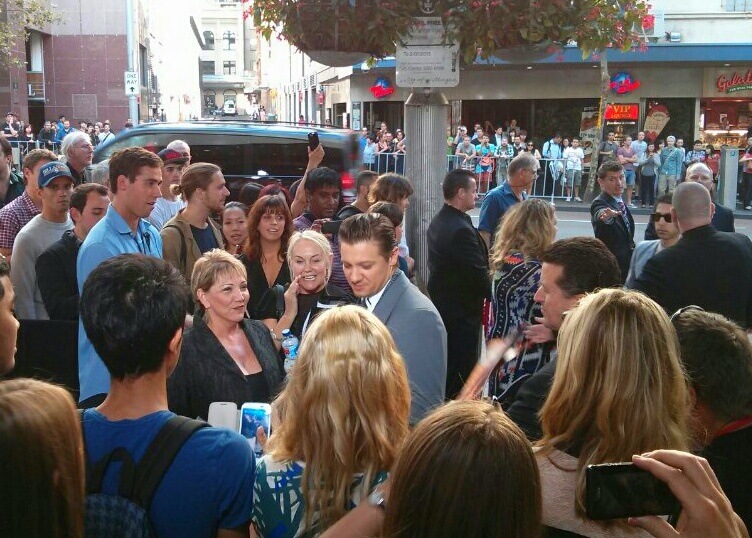
For some reason, Jeremy Renner showed up at a local movie theater. It was a pretty big deal and I just happened to be walking up the street as he was getting out of a limo. Seemed like a pretty gracious guy.
That’s about it. Let’s see what I can explore today…
Hello Sydney!
Today I arrived in Australia! Well, unless you’re reading this from the US, in which case… Tomorrow I arrived in Australia! Send me a PayPal gift and I’ll let you know who wins the Superbowl.
A 14-hour overnight flight becomes a hazy mixture of napping, drooling, sub par meals, foreign odors, neck pain, and peeing. Much like a nursing home, I’d imagine. It’s kind of scary to think that there’s nothing below you for thousands of miles but ocean, so every little bit of turbulence makes me wonder if I’ll be reprising the role of Jack on Lost. If that means I get to hook up with Kate then I’m OK with it. Screw that Sawyer dude though.
Overall, the passengers around me were quite pleasant; no crying babies, no kids kicking the back of my seat, no chronic personal space violators. Of course, you always want to sit next to a local so you can pick his or her brain about your destination. In true karmic fashion, I happened to sit next to two Cajun cousins, one of whom lives minutes from the little Louisiana town in which my father grew up and the other lives two hours north of my hometown in Kentucky. They’re in their 50s, best friends, and are off to explore New Zealand. Pretty awesome.
It’s rainy here in Sydney today so it looks like I’ll be researching indoor activities. Cheers!
Happiness Redux
My buddy Mike and I attempted a near-impossible 5-hour snowshoeing expedition in the unforgiving mountains of Big Cottonwood Canyon in Utah. We buried supplies along the way to be dug up on our return. This video documents our experience at the last cache of supplies.
(If this makes no sense at all then you need to watch the video posted on 1/21.)
Happiness
When was the last time you were so happy that you practically couldn’t contain yourself? The back story for the following video involves a guy who did a 90-day solo expedition to the South Pole, and along the way he buried supplies in the snow to be dug up on his return. This video documents his experience at the very last cache of supplies, where he finds cheese puffs, chocolate, and mentos.
I hope it puts a smile on your face. 🙂
Fontana Overlook
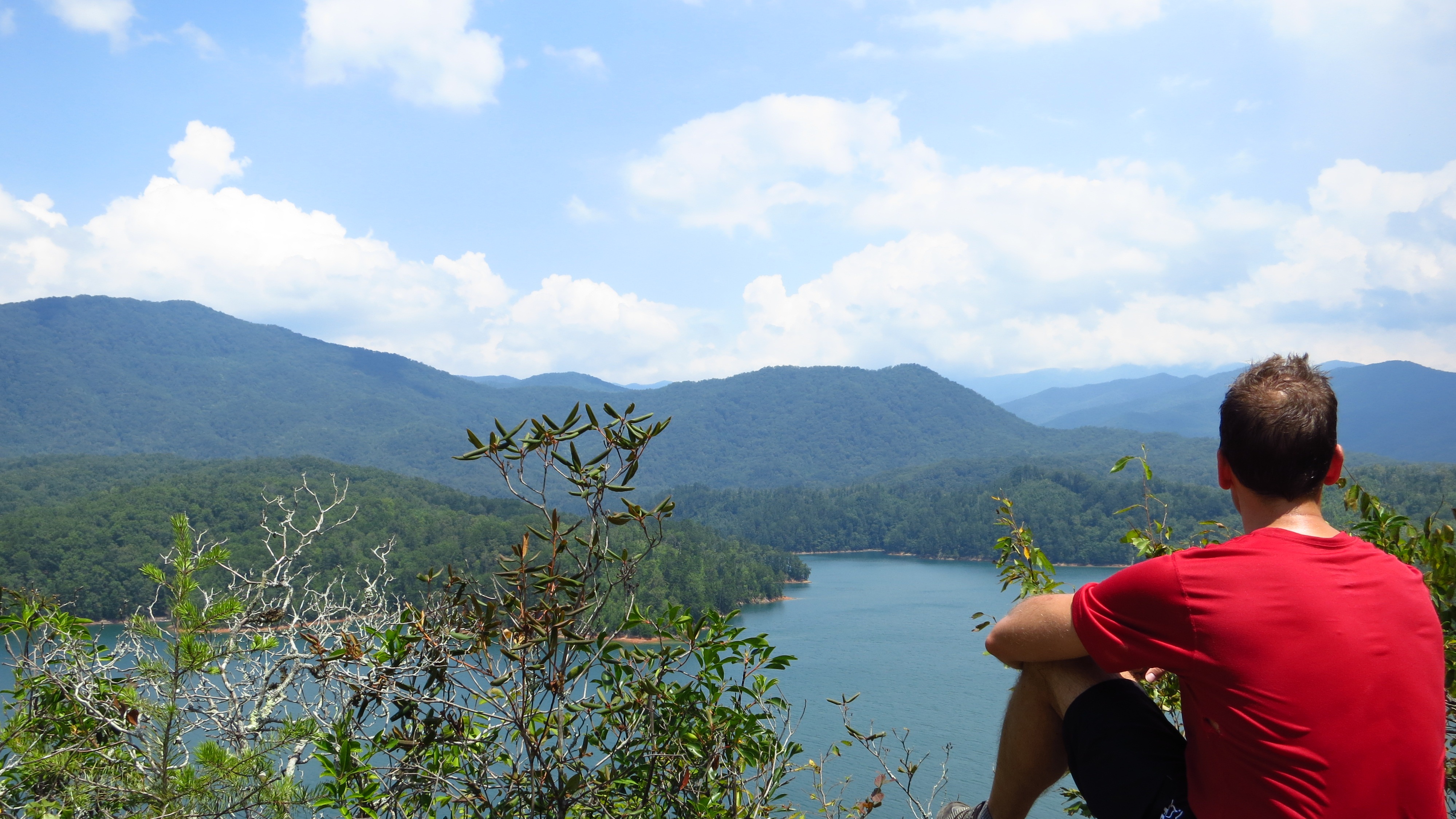
Checking out the view of Fontana Lake at Tsali in NC, USA.
I learned early that the richness of life is found in adventure. Adventure calls on all the faculties of mind and spirit. It develops self-reliance and independence. Life then teems with excitement. But man is not ready for adventure unless he is rid of fear, for fear confines him and limits his scope. He stays tethered by strings of doubt and indecision and has only a small world to explore.
— William O. Douglas
 kentuckyfriedscott